This video runs 18 minutes (4 laps). Following the 458 Italia on the last lap is especially fun. The camera car is a Superformance, I think. The speed range, from 160 k.p.h. to 220 k.p.h., is from about 100 m.p.h. to 136 m.p.h.
http://www.youtube.com/watch?v=-_YdH-AHXow&feature=g-upl
Thursday, September 6, 2012

Wednesday, September 5, 2012
That'll Do (Ferrari 315 S)
 |
| Two distributors, 3.8 liters 4 cams, 12 cyclinders, 12 carb throats, 24 plugs, 350+ horses. Ferrari's big 4-cam V-12 sports cars (from 3.8 to 4.5 liters) had massive power but poor handling. They disappeared after 1957, partly because of Alfonso de Portago's crash in the Mille Miglia, which killed 13 people including him and his co-driver. For 1958, the FIA limited racing sports cars to 3 liters. This change launched the careers of the most memorable front-engined sports racing cars like the Ferrari 250 Testa Rossa, the Aston Martin DBR-1, and the Maserati Tipo 61 "Birdcage." |
 |
| In 1957, Piero Taruffi won the last Mille Miglia in this Ferrari 315 S and retired from racing. Two years later his daughter Prisca was born. She has had a career in motor sports and journalism in Italy. Taruffi's Mille 315 S is owned by John McCaw, the U.S. cell phone billionaire. On the 50th anniversary of Taruffi's win, he invited Prisca to drive it in the modern Mille rally. |
 |
| Prisca Taruffi with her father's helmet and goggles. |
 |
| "I have found the silicone spray, Giuseppe, but where is the guest driver?" |
 |
| Two months after the Mille, Enzo Ferrari shipped Taruffi's car to his Man In America, Luigi Chinetti, who entered it in the Road America 500 at Elkhart Lake. Phil Hill drove the race solo, and led from flag to flag. This drive launched his international career by getting him a Ferrari factory drive for 1958. |
 |
| Piero Taruffi with Prisca's mother, probably after a Mille Miglia, but not his 1957 overall win. He was one of those drivers who's career was shortened by World War Two (another was the acknowledged pre-war "master," Tazio Nuvolari). By 1952, when Taruffi won the British Grand Prix, his hair was white. He was also the type of driver who liked to see how the race developed before making his move. Thus his nickname, "The Silver Fox." |
Tuesday, September 4, 2012
Feel Free To Jump On In...
Well, PA Members...
Pilote is temporarily out of (ahem...) worthwhile daily posts. So feel free to jump on in. Have said before and will say again that a blog touching on the Dragon needs biker voices. Hard to believe that RC 51 doesn't have some great Dragon stories...
I also think a biker/cager dialogue would be fun. It almost never happens. Everybody who reads this blog regularly has ridden some.
Can set you up as an authorized poster any time. Just let me know when you're ready by posting a comment in any window.
Am out of even remotely interesting travelogue pix and am not going to put up posts just for the sake of it, no matter how opinionated I am... ;-) Maybe when the "new shoes" for my Civic show up later this month I'll have something worth saying.
Monday, September 3, 2012
The ALMS-Grand Am Merger
When Pilote began making tenative plans to attend the ALMS round at Road America next year, little did he know he'd be attending a wake. Yesterday Speed.com reported that ALMS will merge with Grand Am in 2014. Today they reported that "the class structure is to be decided, especially as it relates to the LeMans classes." And it seems clear enough from the reporting that Don Panoz "is selling what is left of ALMS," as Dave Despain put it, to the France family interests, not merging. If there is a consolidated 18-race schedule Stateside, it is hard to imagine the teams taking a month off to prepare for Le Mans. Bye-bye Le Mans GT rules.
This is sad news. Apparently we'll have a sort of Trans-Am running with Daytona Prototypes. I'm guessing three classes: small bore and big bore GT's, and Daytona Prototypes. Farewell BMW and Ferrari, most likely. The US is Corvette's biggest market, so they're in, even if it takes a new car (which will probably be cheaper and simpler to build anyway). The next gen Mustang is rumored to have independent rear suspension, so hello Mustang. Porsche seems to be able to come up with a 911 for any occasion, so they're probably in.
I get antsy when the NASCAR influence gets anywhere near the racing I love. It's never about technology and courses; it's always about "parity" enforced with a heavy hand and "the show." It says something about both series that ALMS couldn't get a TV contract and Grand Am couldn't get spectators at its events. Watching ALMS on ESPN3 has been delightful: really good race and color announcing. I've never had the slightest desire to watch a Grand Am race in person.
I suppose Grand Am will try to bury Sebring with the 24 Hours of Daytona, and for me personally, Sebring would be no great loss. (Panoz retains ownership of Sebring and Road Atlanta. Maybe Sebring will hobble on with the European teams using it as a tune up for Le Mans, as they always have.) Not that Daytona has ever been a great race: it's just a long one on a mickey-mouse course. Some suggest that dual bills with IndyCar are possible for the "great" courses like Road America. (Watkins Glen is a natural fit with its NASCAR connection.) But IndyCar runs dumb street courses 33% of the time and ovals another 33%.
My fear is that pro sports car racing will lose some great courses, like Lime Rock, Mosport, and Road Atlanta, and gain some turkeys like Belle Isle, Homestead, and New Jersey Motorsports Park. And that we'll lose the high-tech variety in ALMS, and gain "spec" GT racers. And, "for the sake of the show" (and the TV contract), races longer than 2 hours will disappear. The long ALMS races are the best ones.
The merger makes perfect economic sense. There's no more room in North America for two front-rank pro sports car series than there was for two front-rank open wheel series. But I'm glad I'll get to see two ALMS races on two of the great courses before it disappears.
 |
| Would you cross the street to see one of these race? I wouldn't. |
 |
| That's more like it... Hail and farewell, ALMS GT |
Sunday, September 2, 2012
2012 Belgian GP
How appropriate that this year's Grand Prix occurred at the end of my travelogue on Belgium! And that Speed TV would air a "sidebar" program on Dan Gurney's 1967 win in his Eagle! Heady stuff for an Ancien.
Of course I watched practice, qualifying, and the race. As posted before, I always watch Monaco and Spa-Francorchamps. Both go back to the 1920's. And, although the Spa and Monaco courses have changed over the years, their essential character has not.
Approriately, it poured during Friday's practice. Spa wouldn't be Spa without rain. Despite the weather, drivers made made data collection laps. What useful data can be obtained in 2-3 laps, sliding around at 7/10's? But I cheer when it rains at Spa (or any road course). Spa separates the brilliant from the merely great; rain separates them even more. Lotus's new "passive" drag reduction system is an interesting technical development. It was surprising to be reminded in qualifying that Fernando Alonso has not won at Spa. He may not have as much natural talent as Vettel and Hamilton in terms of pure speed, but he has better race craft. Because of the rain, and because most teams had trick new parts to try, nobody had their set-up dialed in. The starting grid was as mixed up as most of this season's races have been.
A pile-up at La Source usually signals a bum race at Spa, and that's what we got. "My" boy Romain Grosjean took took out half a dozen cars, including himself. Alas, two others were Lewis Hamilton and Fernando Alonso. This is the second time Grosjean has wrecked Hamilton at Spa. I may have to reconsider my fanship, his aviator sunglasses to the contrary notwithstanding. The pile-up gave Jensen Button a free-ride, one pit-stop, victory. Vettel also drove a one-stopper to 2nd place from 12th on the grid, showing some superb car-control when he and Michael Schumacher arrived at pit-entry at the same time and his instruction from Red Bull was "do the opposite of Schumacher." Kimi Raikkonen's Lotus let him down (not up to pace): he should have come a strong 2nd. But his outside pass on Schumacher in Eau Rouge will be in the highlight reels for years.
I wish Porsche had not forced John Wyer to fire David Hobbs before the 1970 season. (Hobbs over-revved his 917 in a winter test, blowing the engine.) Hobbs understands Spa and drove Old Spa at the sharp end of the 1000 kilometer races there in Wyer's Ford GT 40's. I would love to know what he could have done with a Porsche 917 there.
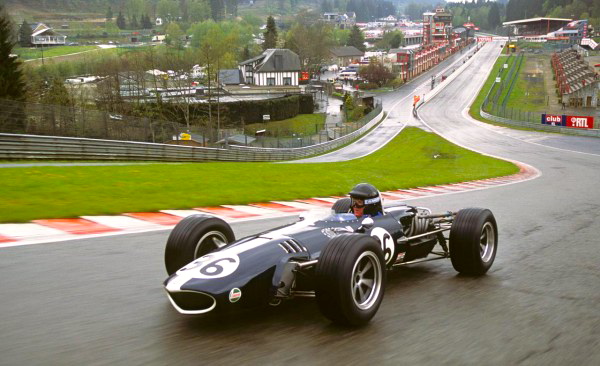 |
Dan Gurney demo-ing his 1967 Belgian Grand Prix winner at Spa (exiting Eau Rouge) on the 35th anniversary of his victory. This segment of the course is way more steeply downhill and uphill than it looks in this photograph. Pilote was reminded/learned of a couple of things in the Speed TV program about this car. It was designed by Len Terry (ex-Lotus). All those rivets on the tub were there because magnesium sheet metal is impossible to weld and hard to bend. Gurney had so many DNF's in this car because the crankcase of the V-12 was long, which interfered with proper oil scavenging by the dry-sump system, which resulted in oil pressure fluctuation. For want of a nail...
|
Of course I watched practice, qualifying, and the race. As posted before, I always watch Monaco and Spa-Francorchamps. Both go back to the 1920's. And, although the Spa and Monaco courses have changed over the years, their essential character has not.
 |
| Antonio Ascari, winner of the first Belgian Grand Prix, in 1925, entering Eau Rouge in his Alfa Romeo P-2. The dirt roads were paved in the 1930's. With the exception of one race in the 1960's and a couple when it was closed to GP events in the 1970's, all Belgian Grands Prix have been run at Spa. |
Approriately, it poured during Friday's practice. Spa wouldn't be Spa without rain. Despite the weather, drivers made made data collection laps. What useful data can be obtained in 2-3 laps, sliding around at 7/10's? But I cheer when it rains at Spa (or any road course). Spa separates the brilliant from the merely great; rain separates them even more. Lotus's new "passive" drag reduction system is an interesting technical development. It was surprising to be reminded in qualifying that Fernando Alonso has not won at Spa. He may not have as much natural talent as Vettel and Hamilton in terms of pure speed, but he has better race craft. Because of the rain, and because most teams had trick new parts to try, nobody had their set-up dialed in. The starting grid was as mixed up as most of this season's races have been.
A pile-up at La Source usually signals a bum race at Spa, and that's what we got. "My" boy Romain Grosjean took took out half a dozen cars, including himself. Alas, two others were Lewis Hamilton and Fernando Alonso. This is the second time Grosjean has wrecked Hamilton at Spa. I may have to reconsider my fanship, his aviator sunglasses to the contrary notwithstanding. The pile-up gave Jensen Button a free-ride, one pit-stop, victory. Vettel also drove a one-stopper to 2nd place from 12th on the grid, showing some superb car-control when he and Michael Schumacher arrived at pit-entry at the same time and his instruction from Red Bull was "do the opposite of Schumacher." Kimi Raikkonen's Lotus let him down (not up to pace): he should have come a strong 2nd. But his outside pass on Schumacher in Eau Rouge will be in the highlight reels for years.
I wish Porsche had not forced John Wyer to fire David Hobbs before the 1970 season. (Hobbs over-revved his 917 in a winter test, blowing the engine.) Hobbs understands Spa and drove Old Spa at the sharp end of the 1000 kilometer races there in Wyer's Ford GT 40's. I would love to know what he could have done with a Porsche 917 there.
Off Topic: Everything Old Is New Again
Off-topic: Mens' Warehouse is running a TV ad that says "There's a new look in men's suits: short jacket, narrow lapels." They must have missed those old kinescopes of the Beatles and Stones performing on The Ed Sullivan Show. Or of Motown's Temptations and Four Tops.
Pilote didn't own a jacket with wide lapels until mirrored disco globes showed up. He's waiting for a Men's Warehouse ad that says "There's a new look in men's suits: wide lapels, slant-cut pocket flaps, flaired pants legs, fabrics in bold plaids. And we have a large selection of paisley ties to go with."
Pilote didn't own a jacket with wide lapels until mirrored disco globes showed up. He's waiting for a Men's Warehouse ad that says "There's a new look in men's suits: wide lapels, slant-cut pocket flaps, flaired pants legs, fabrics in bold plaids. And we have a large selection of paisley ties to go with."
Saturday, September 1, 2012
Farewell to Belgium and France
If you have been reading recent posts regularly, it may surprise you that we didn't visit Paris or Brussels (or another large city like Antwerp). We did that on an earlier trip. I enjoyed Brussels thoroughly. It is very walkable and intimate for a large city. I liked Paris, but it is expensive. And on this trip, we had a checklist of things we wanted to see in the countryside.

When we landed at Charles de Gaulle, I asked about renting a Honda Civic Type R, the European equivalent to the Si in the States. The guy at the EuropCar counter laughed and laughed. On our previous trip, we'd asked about a performance upgrade and were offered a Peugeot V-6 convertible at an outrageous price. If you want to rent a hot car, make your arrangements before you leave the States. And expect to pay through the nose.
The standard rental is a 1.5 liter diesel four-door. It's Europe's basic transportation, equivalent to a mid-sized American car in their minds. Think "VW Golf diesel." A Jetta is an upgrade. These cars are perfectly OK, especially with fuel cost at $7.00 per gallon. They easily handle two large suitcases and the rest of your "stuff." If you drive them foot-to-floor you will pass sensible Europeans; they cruise comfortably at 120 k.p.h. (75 m.p.h.). We cruised one Autoroute at 85. Driven hard this way, they get about 30 m.p.g. Fuel is sold by the liter, which is about 25% of a gallon. So the price at the pump looks familiar and reasonable until you remember you're pumping 4 times as many units.
And they are fun enough. They have plenty of torque up to 3000-4000 r.p.m. Then it's time to shift up and bury the throttle again. They are quiet, and smoke and hassle-free: not your father's Oldsmobile diesel. Five-speed boxes; an automatic rental costs extra. On a previous trip, we exchanged a diesel for a 1.8 liter gasoline Peugeot. I would not do it again: the fuel consumption increased far more steeply than the fun factor.
Our Citroen was broken into in the public underground parking garage in Charleroi. It was a smash-and-grab and, fortunately, anything worth grabbing was already in our hotel. In retrospect, we could have seen it coming: a Paris Metro plate on a car left unused for two overnights in a Belgian city. Petty thieves in larger towns "case" public parking spaces and strike in the wee hours of the morning. But the experience was painless. We phoned EuropCar at the Charleroi airport and they said "bring it out and we'll exchange it." Their insurance paid for the glass.
 |
| Chateau Bouillon on the Semois River. Geoffrey of Bouillon sold it to the Bishop of Liege (!) in 1082 to finance his share of the cost of the First Crusade. It was a strong point on the French-Belgian border from the 900's to the late 1600's, when Sebastien Vauban, Louis XIV's great military engineer, installed cannons. It was garrisoned until the invention of breach-loading artillery. |
 |
| La Roche en Ardenne, on the Ourthe River. Today it is a popular tourist destination for kayaking, canoeing, mountain-biking, and other outdoor sports. But it goes back to the Neolithic Period, circa 700 B.C.E. There's a castle here too, used from the 800's to the 1700's, but I chose to enjoy the pretty little town rather than hike up another steep hill to another ruin. |
 |
| World War Two Memorial in La Roche en Ardenne (above and below). This picture shows what lousy tank country the Ardennes are. This Sherman didn't make it. Although it was fitted with the "new" (1944) 76 m.m. high-velocity cannon, Shermans were still outgunned by the 88 m.m. cannons on German Tigers and King Tigers. This one took an 88 round through the glacis. La Roche en Ardenne was heavily bombed by American tactical air in December, 1944. 116 civilians were killed. Nevertheless, as the plaque shows, Belgians remain grateful for liberation by the Allies generations later. Europe reminds me of the William Faulkner quote: "The past isn't history-- it isn't even past." |

 |
| The Butte de Lion Memorial at Waterloo. As battlefields go, Waterloo is dead flat. So we can guess from the size of this man-made hill that Napoleon's opponents were relieved to send him off to exile on St. Helena in the middle of the Atlantic Ocean. |
 |
| Not all medieval structures in France and Belgium have been in continuous use, or restored. This is the ruin of the church at the Abbaye de Villers in Belgium (near the Waterloo battlefield). The Abbey was started by Cistercian Monks in 1146. The church was completed around 1300. At its height, the Abbey controlled a considerable amount of farm land and was the economic engine that drove a large regional economy. But as Europe modernized and urbanized, it fell on hard times. it was abandoned in 1796 after the French Revolution. Since the 1970's, it has been gradually restored as a tourist attraction. |
 |
| Another example: the unrestored ruins of the Cathedral of Soissons (France). This picture shows how Europeans don't go to a park to visit their history. They live next door to it. In the main traffic circle in the center of town is yet another memorial, to the Franco-Prussian War of 1870. Its base is pock-marked where bullets and cannon shells hit it in World War Two. One way to look at the postwar European Union is as an attempt to put 2000 years of warfare behind. As Kurt Vonnegut put it: "World War One and World War Two: Western Civilization trying to commit suicide. Twice." |
 |
| Our Renault Modus in La Roche en Ardenne. A short essay on renting cars in Europe follows. |
When we landed at Charles de Gaulle, I asked about renting a Honda Civic Type R, the European equivalent to the Si in the States. The guy at the EuropCar counter laughed and laughed. On our previous trip, we'd asked about a performance upgrade and were offered a Peugeot V-6 convertible at an outrageous price. If you want to rent a hot car, make your arrangements before you leave the States. And expect to pay through the nose.
The standard rental is a 1.5 liter diesel four-door. It's Europe's basic transportation, equivalent to a mid-sized American car in their minds. Think "VW Golf diesel." A Jetta is an upgrade. These cars are perfectly OK, especially with fuel cost at $7.00 per gallon. They easily handle two large suitcases and the rest of your "stuff." If you drive them foot-to-floor you will pass sensible Europeans; they cruise comfortably at 120 k.p.h. (75 m.p.h.). We cruised one Autoroute at 85. Driven hard this way, they get about 30 m.p.g. Fuel is sold by the liter, which is about 25% of a gallon. So the price at the pump looks familiar and reasonable until you remember you're pumping 4 times as many units.
And they are fun enough. They have plenty of torque up to 3000-4000 r.p.m. Then it's time to shift up and bury the throttle again. They are quiet, and smoke and hassle-free: not your father's Oldsmobile diesel. Five-speed boxes; an automatic rental costs extra. On a previous trip, we exchanged a diesel for a 1.8 liter gasoline Peugeot. I would not do it again: the fuel consumption increased far more steeply than the fun factor.
Our Citroen was broken into in the public underground parking garage in Charleroi. It was a smash-and-grab and, fortunately, anything worth grabbing was already in our hotel. In retrospect, we could have seen it coming: a Paris Metro plate on a car left unused for two overnights in a Belgian city. Petty thieves in larger towns "case" public parking spaces and strike in the wee hours of the morning. But the experience was painless. We phoned EuropCar at the Charleroi airport and they said "bring it out and we'll exchange it." Their insurance paid for the glass.